Tuesday, October 15, 2013

Boehner proposes six-week extension to US debt limit | World news ...

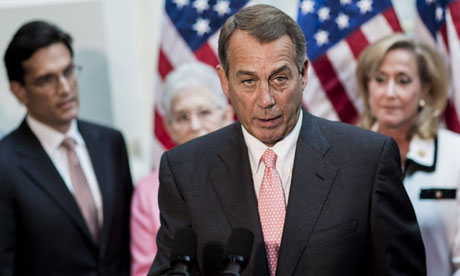
John Boehner, House speaker

Boehner and other Republicans are due to meet Obama at the White House on Thursday afternoon. Photograph: TJ Kirkpatrick/Corbis


Republican leaders have backed away from their immediate threat to freeze US debt limits, offering the first real hope of a wider solution to the budget crisis that continues to paralyse much of the federal government.

Wall Street markets surged on Thursday after House speaker John Boehner emerged from a party meeting to announce a proposal that would allow a six-week extension to the debt limit that would otherwise be reached by 17 October.

But Republicans refused to bring an end to the separate impasse over the government shutdown that has dragged on since the beginning of October, repeating their insistence that they will only pass a resolution to authorise continued government spending if Barack Obama agrees to negotiate an array of concessions.

Until now, the president has said he would only negotiate if Republicans agreed to lift both threats – extending the debt limit and passing a continuing resolution without strings attached.

Boehner and other Republicans are due to meet Obama at the White House on Thursday afternoon, and hope that their short-term offer on the debt ceiling might enough to persuade the president to drop his demand to end the shutdown first.

"We are hopeful that that this is the beginning of meaningful discussions," said Cathy McMorris Rodgers, chair of the Republican House conference.

The White House gave a cautious welcome to the Republican offer, but stressed it would need to see the exact wording before deciding whether it was enough to proceed with formal talks. The president is "happy that cooler heads seem to be prevailing," said spokesman Jay Carney. "We would prefer to see a longer term resolution," he added.

Republicans have been under intense pressure from business leaders and donors to avoid a possible US default by removing the debt ceiling threat from their arsenal. But there is no guarantee that the more conservative Republicans in Boehner's caucus will support it.

US stock markets soared on the news. The Dow Jones Industrial Average had risen over 230 points (1.56%) shortly after Boehner's press conference ended. The S&P 500 rose over 27 points (1.67%).

PNC Bank senior economist Gus Faucher said: "This is an indication at least that we will get a deal on the debt ceiling. That's what has been worrying investors more than the government shutdown."

Faucher added, however, that the uncertainty was already a drag on the economy, and failure to reach a deal on the debt limit would a "significant negative and long lasting impact" on the economy.

Bruce Bittles, the chief investment strategist at RW Baird & Co, said investors had become more concerned about the possibility of a debt default in recent days, but that in general they were "complacent" and had discounted the possibility of a default despite the war of words in Washington.

During the last row over the debt ceiling in 2011, markets the S&P dropped close to 20%. "So far we have seen modest selloffs. My fear is that if we are just kicking the can down the road, that's not a solution," Bittles said.

Earlier on Thursday the Treasury secretary, warned on Thursday there were unpredictable consequences of the continued brinksmanship, including the possibility that the US could run out of cash within days.

Lew accused Republicans of underestimating the danger of inadvertently triggering a stampede among investors that could rapidly drain remaining reserves.

More than $100bn of the US debt, known as Treasury bonds, is typically reissued every week as investors roll over their loans to the government. This process is usually routine and does not add to the $17tn US debt pile, but simply refinances a portion of it.

But markets have already been spooked by Republican threats to refuse to extend the debt limit if they do not extract concessions on healthcare reform. Short-term borrowing costs nearly tripled in a bond auction on Tuesday as investors feared there was a risk that interest and capital repayments could be missed.

A similar wariness to roll over bonds expiring next week could exhaust a $50bn cash reserve at any point, warned Lew. "Trying to time a debt limit increase to the last minute could be very dangerous," he said in written congressional testimony. "If US bond holders decided that they wanted to be repaid rather than continuing to roll over their Treasury investments, we could unexpectedly dissipate our entire cash balance."

Answering written questions by members of the Senate finance committee, he added: "I very much fear that miscalculation is something that could have devastating consequences. It is impossible to predict with any degree of accuracy when we will run out of money."


Source: http://www.theguardian.com/world/2013/oct/10/john-boehner-six-week-debt-limit-extension
Tags: once upon a time   Arsenio Hall   Asap Rocky   lil kim   suits  

Va. race previews shutdown politics for 2014

RICHMOND, Va. (AP) — Playing out just across the Potomac River from shutdown central, the Virginia governor's race has turned into a real-time test of Republican and Democratic positions in the congressional budget battle raging in the nation's capital.


With polls indicating more public resentment toward Republicans than Democrats, the federal work stoppage directly affecting thousands of Virginia residents has forced Republican Ken Cuccinelli on the defensive while giving Democrat Terry McAuliffe an opening in a race that had been neck-and-neck for months.


Now, public and internal surveys show voter support has started breaking McAuliffe's way, with the Democrat leading by 8 percentage points in a Quinnipiac University poll released Thursday. The same poll showed that by a nearly 3-1 majority, Virginians opposed Congress shutting down the government in a fight over President Barack Obama's health care law.


The outcome of the Nov. 5 election in this swing-voting state could provide clues about how the issue will play in next fall's House and Senate midterm elections — and give both parties a road map as they fight for control of Congress.


Cuccinelli, the conservative state attorney general, has sought to carefully distance himself from House GOP leaders and tea party lawmakers without alienating his conservative core supporters or moderate independents — particularly in the affluent and fast-growing Washington suburbs.


Earlier this month, Cuccinelli called on congressional Republicans to drop their insistence that Congress dismantle the health care law as a condition for reopening the government. Two days later, he appeared at a conservative Christian group's fundraiser that Sen. Ted Cruz, R-Texas, also attended. But Cuccinelli didn't make any public mention of Cruz, the tea party hero who led the Senate GOP's effort to defund the health care law.


Cuccinelli has lambasted McAuliffe for saying he wouldn't sign a Virginia budget that didn't include a Medicaid expansion, the mechanism the health care law uses to extend coverage to the poor.


To people in Virginia, Cuccinelli said, McAuliffe's position amounts to "a government shutdown."


McAuliffe is a former national Democratic Party chairman and a friend of former President Bill Clinton and his wife, former Secretary of State Hillary Rodham Clinton. McAuliffe has been stoking the notion — on the campaign trail and in TV ads blanketing the state — that Republicans are to blame for the shutdown and that Cuccinelli is no different from those whose demands helped trigger it. He's sought to link Cuccinelli to the tea party and paint him as too ideologically extreme for Virginia.


"I wouldn't even be in the same room with Ted Cruz with the damage he has brought to so many Virginia families," McAuliffe said. "And if I'd gone to the room, I'd tell him to stop using a government shutdown as an ideological bargaining chip."


The arguments are salient in this state, which is home to many federal employees and receives the most military spending per capita in the nation.


Cuccinelli's political adviser, GOP strategist Christopher J. LaCivita, acknowledged that the shutdown has created a challenge for his candidate at a critical time, saying, "We don't get to talk about the good stuff Ken would do as governor."


Josh Schwerin, a senior aide to McAuliffe, said the shutdown played right into his candidate's key argument against Cuccinelli and the tea party: "They're more concerned about pushing their ideological agenda than solving problems."


Downright nasty now, the race has been very negative from almost the start because it pitted two deeply unpopular candidates against each other.


Majorities of Virginia voters long have viewed Cuccinelli and McAuliffe in a negative light, and both brought considerable political baggage into this fall's only competitive governor's race.


Cuccinelli is testing the notion of whether a Republican as conservative as him can win in a swing-voting state.


He was the first attorney general in the nation to challenge the new health overhaul law. A global-warming skeptic, he mounted a two-year inquest into whether a former University of Virginia climate scientist used manipulated data to land federal grants. And only weeks after taking office, Cuccinelli warned Virginia's public college officials that they could not enact policies against discrimination toward gays that are tougher than state law, an action Gov. Bob McDonnell, a fellow Republican social conservative, rescinded.


As attorney general, Cuccinelli pressured members of the State Board of Health to reverse their decision to exempt existing abortion clinics from new regulations that hold facilities where a certain number of abortions are performed to the stringent architectural requirements of hospitals. The board ultimately decided to apply the standards to existing clinics.


Since March, Cuccinelli has been dogged by his ties to a wealthy benefactor whose more than $145,000 in personal gifts and loans to McDonnell and his family remains a subject of federal and state criminal investigations. Cuccinelli accepted $18,000 in gifts from that benefactor, Jonnie R. Williams, chief executive of a Virginia-based nutritional supplements company.


The governor's scandal not only stained Cuccinelli, it drowned out his campaign's message throughout the spring and summer, and it sidelined his most formidable advocate and fundraiser, the sitting governor.


McAuliffe, with his vast national network of donors, has raised nearly twice as much as Cuccinelli.


But he's had his own troubles.


McAuliffe headed a small electric-car company that bypassed Virginia to set up operations in north Mississippi two years ago. Now federal authorities are investigating the company's use of a federal program that grants visas to foreign investors who put at least $500,000 into qualifying American-grown business ventures. McAuliffe was the company's chairman for three years before quietly stepping down after declaring his candidacy last November.


Last week, McAuliffe's name surfaced on a list of investors with a Rhode Island estate planner who is now jailed for using the stolen identities of terminally ill people to secure annuities on them without their knowledge, then collecting insurance benefits when they died.


There is no allegation of wrongdoing by McAuliffe or that he or other investors knew of efforts to defraud the terminally ill. McAuliffe said he was only a passive investor and unaware of the scheme.


The Associated Press last Wednesday initially reported McAuliffe was accused in court documents of having lied to a federal investigator looking into the benefit scheme, but then said the reporting was wrong and withdrew the story. The documents referred to someone by the initials "T.M.," but did not identify McAuliffe as that person.


Source: http://news.yahoo.com/va-race-previews-shutdown-politics-2014-061656473--election.html
Related Topics: nhl   mariano rivera   Big Brother 15   phoebe cates   Clint Dempsey  

Shutdown deal in sight? Reid, McConnell optimistic

WASHINGTON (AP) — Racing the clock, the Senate's Democratic and Republican leaders closed in on a deal Monday night to avoid an economy-menacing Treasury default and end the two-week partial government shutdown.


"We've made tremendous progress," Senate Majority Leader Harry Reid declared after an intense day of negotiations with Senate Republican leader Mitch McConnell and other lawmakers. "Perhaps tomorrow will be a bright day," he said, suggesting agreement could be announced soon after weeks of stubborn gridlock.


McConnell also voiced optimism — although not as much as Reid, D-Nev., had — and the details under discussion generated little if any satisfaction among rebellious House conservatives.


Officials said that in the discussion to date, the $16.7 trillion federal debt limit would be raised enough to permit the Treasury to borrow normally until mid-February, if not a few weeks longer.


The government would reopen with enough money to operate until mid-January at levels set previously, and agencies would be given flexibility in adjusting to reduced funding levels imposed by across-the-board spending cuts.


Officials cautioned that those details could change, and there was even more uncertainty about other elements of a possible deal.


Under discussion was a one-year delay in a $63 fee imposed on companies by the health care law known as Obamacare for everyone covered by an employer-sponsored plan. By day's end, though, Republican opposition to the provision placed it in jeopardy — just as Democrats had earlier pushed back against the proposed repeal of a medical device tax contained in the health care law.


The two sides were also discussing a requirement that individuals seeking subsidies under the health care law to pay for coverage would be subject to stronger income verification measures.


The government has been partly closed since Oct. 1, and the Obama administration says the Treasury will run out of borrowing authority to fully pay the nation's bills on Thursday.


The result has been a partisan showdown that polls show is alienating all sectors of the electorate except tea party supporters — and has been a big political loser for Republicans.


As a midweek deadline for raising the debt limit neared, the stock market turned positive on bullish predictions from the two longtime antagonists at the center of the talks, Reid and McConnell.


Though McConnell expressed optimism about an agreement, his words were not as strong as Reid's. "We've made substantial progress, and we look forward to making more progress in the near future," he said as the Senate adjourned for the evening.


At a mid-day visit to a charity not far from the White House, President Barack Obama blended optimism with a slap at Republicans.


"My hope is that a spirit of cooperation will move us forward over the next few hours," he said. And yet, he added, "If we don't start making some real progress both in the House and the Senate, and if Republicans aren't willing to set aside some of their partisan concerns in order to do what's right for the country, we stand a good chance of defaulting."


Stock prices, which had risen strongly late last week on hopes of an agreement, were down at the start of the day but then pushed higher as the Senate leaders voiced optimism. The Dow Jones industrial average rose 64 points.


Reid and McConnell met twice before midafternoon, their sessions sandwiched around a White House announcement that Obama was calling them and the party leaders in the House for the second time in less than a week to discuss the economy-threatening crises. The meeting was subsequently postponed and it was not clear when it might be rescheduled.


Any legislation would require passage in the Senate and also in the House, where a large faction of tea party-aligned lawmakers precipitated the shutdown two weeks ago despite the efforts of both McConnell and Republican Speaker John Boehner.


Boehner met with McConnell during the day, then with other House GOP leaders. His spokesman, Michael Steel, later said, "If the Senate comes to an agreement, we will review it with our members." A closed-door session was set for Tuesday morning.


One conservative with a seat at the GOP leadership table, Oklahoma Rep. James Lankford, said that based on what he had been told, the emerging package contained no policy victories for his party. As for raising the debt limit until February, he said, "That's a lot of dollars."


In addition to other elements of any deal, the two Senate leaders are expected to announce that House and Senate negotiators will seek a deficit-reduction agreement that could ease or eliminate a new round of automatic federal spending cuts scheduled to begin in January. While the current round of these cuts fell on both domestic programs and the military, the new reductions would hit primarily the Pentagon.


Democrats were resisting a Republican-backed proposal to suspend a medical device tax that was enacted as part of the health care law.


The officials spoke on condition of anonymity, saying they were not authorized to comment on the private discussions.


The president and a wide array of economists, bankers and politicians in both parties — at home and backed by world leaders — have all warned that default could have catastrophic consequences for both the domestic and global economies.


The doubters alternatively say no default will occur or that if it does, it won't be the calamity that others claim.


But after holding center stage for much of the current impasse, there was little doubt that they had been shunted aside as Reid and McConnell worked toward an agreement.


The prospect of a default and the possibility of a follow-on recession largely overshadowed the partial government shutdown that has furloughed 350,000 federal workers. Government research labs have been affected, veterans' services curtailed and much of the Occupational Safety and Health Organization shuttered.


With federal parks off-limits to visitors, the impact on tourism prompted several governors to petition Interior Secretary Sally Jewell successfully to permit the states to finance some re-openings.


The shutdown began on Oct. 1, at the beginning of the budget year, after the House adopted a strategy of conditioning broad federal spending legislation to a proposal to starve the three-year-old health care law of funding.


The president and Democrats refused, and the bruising struggle began, merging quickly with the fast-approaching deadline for a debt limit increase.


In the two weeks since, public opinion polls have charted a steady decline in Republican approval ratings, and an increase in the view that the party's lawmakers are acting out of political motivation.


The shutdown has proved problematic for the GOP in the Virginia governor's race, which is on the ballot this fall. Public opinion polls show the Democrat, Terry McAuliffe, ahead of Republican Ken Cuccinelli, who is caught between tea party supporters on the one side and the public's general unhappiness on the other, magnified by the large presence of federal workers in the state.


___


Associated Press writers Donna Cassata, Andrew Taylor, Alan Fram, Henry C. Jackson, Julie Pace, Jim Kuhnhenn and Ricardo Alonso-Zaldivar contributed to this report.


Source: http://news.yahoo.com/shutdown-deal-sight-reid-mcconnell-optimistic-232258734--finance.html
Related Topics: LC Greenwood   Eiza González   monday night football  

Friday, October 11, 2013

Mixed start on Wall Street as debt talks continue

NEW YORK (AP) — The stock market is getting off to a mixed start as talks continue in Washington over ending a budget impasse that has shut down the government and threatened the U.S. with default.


The Dow Jones industrial average inched up five points to 15,132 points in the first few minutes of trading Friday. It surged 323 points the day before as investors hoped that signs of a compromise from House Republicans would defuse the standoff.


The Standard & Poor's 500 index edged down less than a point to 1,691. The Nasdaq composite also fell less than a point to 3,760.


Two big U.S. banks reported mixed results. JPMorgan Chase's stock rose after its earnings excluding a big legal expense came in better than analysts expected. Wells Fargo's revenue missed targets.


Source: http://news.yahoo.com/mixed-start-wall-street-debt-talks-continue-134955466--finance.html
Tags: liberace   Ios 7 Release Date   jadeveon clowney   amber heard   Edward Snowden